- drparikhrushabh@gmail.com
- +91 8779697851, 9619810512
- Mon - Sat: 10:00am to 6:00pm (Sunday Closed)


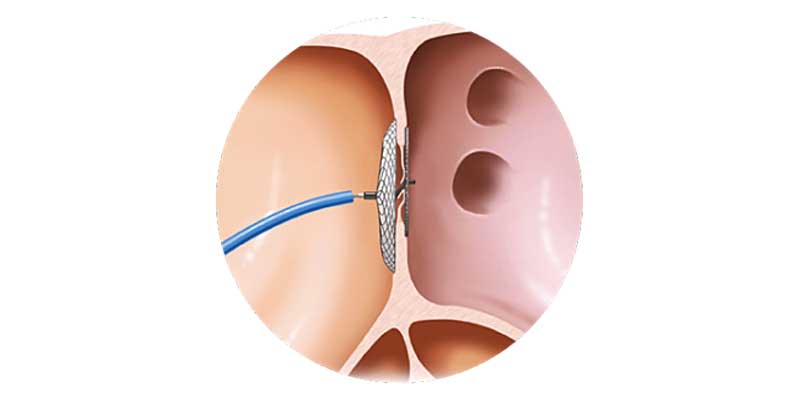
Patent Foramen Ovale Closure (PFO) Device
What is PFO ?
The foramen ovale is a communication between the left and right sides of the heart that allows blood to bypass the lungs in a developing fetus, and is normally closed after birth when breathing begins. Complete closure (patency) does not occur in about 20% of the general population, and it may be an important cause of stroke in people under the age of 50. While stroke is uncommon in this age group, about 50% of those who do experience some form of stroke and are aged less than 50 have a patent foramen ovale (PFO).
What is an Agitated Saline Contrast Study ?
An agitated saline contrast study (“Bubble study”) is recommended for where there is a concern for a patent foramen ovale (PFO).
Before doing the bubble study, a full standard transthoracic echocardiogram is performed. An intravenous cannula is then placed in an arm vein by the nurse or cardiologist. The cardiologist will explain the test to you further before proceeding. This is a very safe and painless test. The cardiologist will inject 10mls of normal saline (“water”) mixed with tiny bubbles into the vein. A second injection is then performed and you will be asked to perform a Valsalva manoeuvre which involves blowing out while your lips are closed - you will be shown how to do this.
After completion of the test, the intravenous cannula is removed and the study is completed. There is no need to fast before the test and you can eat and/or drink as you wish. If needed , the test can be repeated with transoesophageal echocardiogram as it shows a more clearer picture of the PFO.
How is patent foramen ovale treated?
Most people with patent foramen ovale won’t need treatment. But your doctor may recommend treatment if you have a history or high risk of strokes or blood clots. Treatments include:
-
Medication to prevent blood clots, such as aspirin or warfarin.
-
Heart surgery, where your surgeon makes an incision and stitches the flap closed. They may suggest surgery if catheterization wasn’t successful. Your surgeon may use open-heart surgery or minimally invasive robotically assisted patent foramen ovale repair. They perform this surgery through small incisions in your chest.
Recent research suggests that PFO closure may help prevent future strokes in people with PFO who’ve had an unexplained stroke.
How can I reduce my risk of patent foramen ovale?
-
You can’t reduce your risk of PFO. But you should get tested for this condition if you have an unexplained (cryptogenic) stroke. That way, you can get prompt treatment if needed.
-
Many children with PFO find the flap seals completely on its own during their first three years. Many people who still have PFO as adults lead long, full normal lives.
Frequently Asked Questions
What is Patent Foramen Ovale (PFO)?
Patent Foramen Ovale is a small opening between the upper chambers of the heart that fails to close naturally after birth and may allow blood to pass from the right side to the left side of the heart.
Why is PFO closure performed?
PFO closure is performed to reduce the risk of stroke, especially in patients who have had an unexplained (cryptogenic) stroke and are found to have a PFO.
When is PFO device closure recommended?
PFO closure is recommended in selected patients with a history of stroke or transient ischemic attack where no other cause is identified and a significant PFO is present.
How is PFO closure done?
The procedure is performed using a catheter introduced through a vein in the leg, through which a closure device is placed to seal the opening in the heart.
Is PFO closure a safe procedure?
Yes, PFO closure is a minimally invasive and generally safe procedure when performed in experienced centers, with a short recovery period.