- drparikhrushabh@gmail.com
- +91 8779697851, 9619810512
- Mon - Sat: 10:00am to 6:00pm (Sunday Closed)


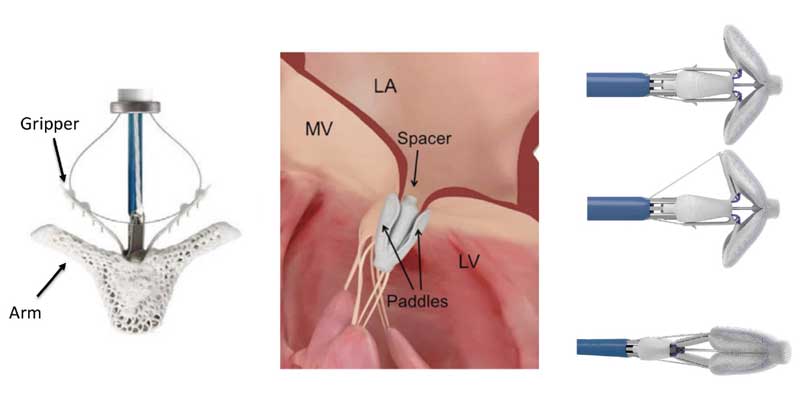
Transcatheter Edge to Edge Repair / Mitraclip
What is Mitral Regurgitation (MR) and what are the symptoms ?
Your heart has four main valves, which work like gates or doors and allow blood to flow through your heart in one direction. Mitral valve regurgitation is a condition in which the heart’s mitral valve does not close tightly. As a result, blood flows backwards into the upper chamber (left atrium) from the lower chamber (left ventricle) as the heart contracts. This reduces the amount of blood that flows through your heart and to the rest of the body. Because of this backflow of blood, the heart has to work harder to pump blood from the left ventricle to the aorta, resulting in an enlarged left ventricle.
It can sometimes make you feel dizzy, tired, out of breath, and you may also experience swelling in your legs and feet (called oedema). If left untreated, mitral valve regurgitation can lead to an irregular heartbeat , heart failure or chest pain.
How is MR diagnosed?
Your cardiologist diagnosed you with severe MR after seeing the results from a transthoracic 2D echocardiogram (TTE). This test and your condition triggered a discussion about the MitraClip therapy. You will need to undergo another test, a transesophageal 2D echocardiogram (TEE), to provide the doctor with the specific measurements of your mitral valve. With the information from this test ,it will be decided for you that you are getting the right procedure, at the right time, along with the best care before and after your procedure. If you are not accepted for a MitraClip procedure, it means you would not benefit from it.
What causes Mitral Regurgitation ?
Mitral valve regurgitation is classified as primary or secondary.
-
In Primary or Degenerative Mitral Regurgitation, there is structural damage to the valve. This can be due to mitral valve prolapse, a congenitally malformed valve, damage from an infection (rheumatic fever, endocarditis), or valve degeneration due to the normal aging process.
-
In Secondary or Functional Mitral Regurgitation, the valve is structurally normal. The valve leaks because the heart is enlarged or damage to the heart muscle has occurred from coronary artery disease or a heart attack.
-
Transcatheter Mitral Valve Repair: The MitraClip™ is available for patients who are high risk for surgery with primary or degenerative mitral regurgitation. It can also be used in patients with functional mitral disease if significant regurgitation remains after optimal medication management has been attempted.
What is Mitraclip ?
A mitral valve clip repairs your damaged mitral valve without the need for open-heart surgery. A small metal clip, about the size of a large staple, is attached to your abnormal part of the mitral valve via a vein in your leg. The clip stays there permanently and helps your valve to function properly again by closing it tightly and reducing the amount of regurgitation through the valve.
This procedure is often recommended for patients who are too high risk for open-heart surgery.
What are the advantages of this procedure ?
The advantage of this procedure is that it is less invasive than open heart surgery and may reduce the amount of recovery time. The small puncture in your groin, where the catheter is inserted, heals quickly. This is a reasonable alternative to medical treatment (i.e., medications) for patients who are not candidates for open heart surgery (such as the very old and frail, patients with very weak hearts and those who have other non-cardiac conditions involving the lungs, kidneys or brain). Patients who have had previous open heart surgery are also considered for the MitraClip procedure because they may be at higher risk for a re-operation.
Frequently Asked Questions
What is TEER / MitraClip?
TEER or MitraClip is a catheter-based procedure that reduces mitral valve leakage by clipping the valve leaflets together without open-heart surgery.
Why is MitraClip performed?
It is performed to treat severe mitral valve regurgitation in patients who are high-risk or unsuitable for surgical valve repair.
When is TEER recommended?
TEER is recommended when mitral regurgitation is severe, symptoms persist despite medical treatment, and surgery is not considered a safe option.
Is MitraClip a safe procedure?
When performed in experienced centers, TEER is considered a safe and effective minimally invasive treatment with faster recovery and improved quality of life.